
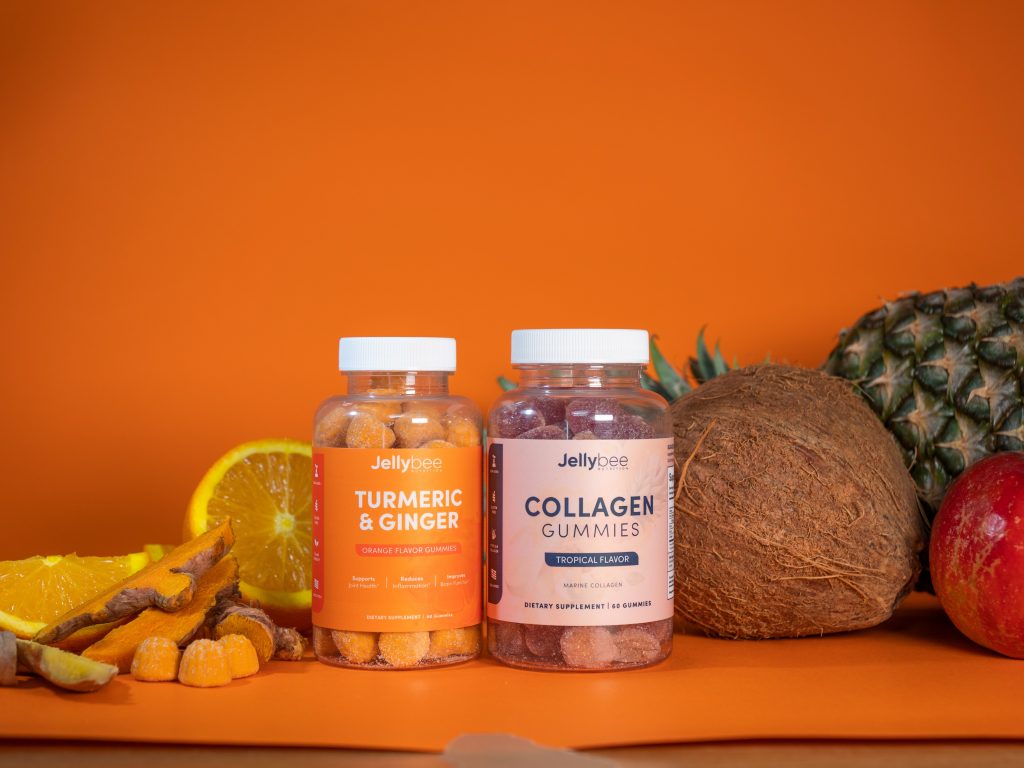
Consuming enough collagen promotes joint health, healing, and repair. But what products should you eat to add more collagen to your diet?
Consuming enough collagen not only to maintain joint health but also to promote healing and repair, 40 g seems to be the amount to consume daily. It is a big dose, so it will require some strategic planning. Here are some of the most collagen-rich foods.
Foods that add more collagen to your diet
1. Bone Broth
5 g per cup
It will depend, but on average, 1 cup would contain around 5 grams of collagen. A good collagen-rich broth is jiggly when cooled.
2. Collagen Hydrolysate Powder (Collagen Peptides)
10 g per a 12 g scoop
Can be added to smoothies of hot chocolate (see below): usually 9 grams of collagen per 10 grams of the product. So to round up, 10 grams of collagen in 12 grams.
3. Hot Chocolate Recipe
10 g per 1 mug
To make 1 mug of delicious collagen-rich hot chocolate:
- Pour one can of full-fat (preferably organic, 70-80%) coconut milk into a small saucepan and heat on medium-low until it simmers.
- Mix in a few squares of dark chocolate (85% and up) and a couple of teaspoons (or tablespoons, depending on how rich you like it) of cocoa powder to taste.
- Sweeten with 2-3 teaspoons of primal-approved sweetener (xylitol, monk fruit, erythritol). Stevia might give it a bitter taste, so test first.
- Stir with a whisk to combine. Slowly whisk in 12 grams of collagen hydrolysate powder (be careful not to mix too fast as it can become lumpy).
4. Gelatinous parts of animals
10 g per 100 g approx.
Cooked beef, pork, or other animals’ cheeks, oxtail, etc: collagen amount will vary, but in 100 g oxtail, there is 30 grams protein, so if the oxtail is 2/3 meat and 1/3 gelatinous matter, there must be around 10 grams of collagen.
5. Wild-caught fish (salmon, cod, tuna, hake)
some amount of collagen (especially in the skin)
There are 14 grams of protein in 100g hake; some of it will be collagen (especially in the skin).
6. Eggs
about 1 g per yolk
Collagen is in the yolk. Do not overcook the yolk; it has to be runny. There is no guideline on how much collagen there is in an egg, but a large yolk contains 2.7 grams of protein, so around 1 gram of collagen.
7. Chia seeds
some
2 tablespoons contain 4 grams of protein, some of which is collagen.
8. Powdered gelatin
12 g per 12 g scoop
Add grass-fed powdered gelatin when reducing your meat/fish sauces and gravies (or make low-carb jello!). Delicious and a huge dose of collagen.
Keep this in mind
Vitamin C helps with collagen absorption in the body, so taking some vitamin C with it is beneficial. How much vitamin C? This study suggests starting with 48 mg of vitamin C per 15 g of collagen.
Final thoughts
The biggest and most trackable sources are 3: bone broth, collagen powder, and gelatin power – added to smoothies, coffee, or hot chocolate. Perhaps it would be easier to build a collagen strategy of consuming 40 g a day by getting the majority of collagen from those 3 sources and adding the rest on top to reach the 40 g goal.
Get free weekly recipes directly in your inbox 💌
Thank you!
You have successfully joined our subscriber list.


